We are now at Chapter 13 in which Jesus shares the Passover meal with His disciples and prepares them for His upcoming death, resurrection, and ascension. In a few days, Jesus would be crucified as a sacrifice offering to God for sin for His followers. Three days after, Jesus would be resurrected to provide eternal life to His followers. 40 days later, Jesus would ascend into heaven to sit at the right hand of the Father and intercede for His followers. One day soon, He will return for His followers so they may dwell with Him forever. At supper, Jesus prepared His disciples first by washing His disciples’ feet as an example of the humble service His followers should perform in His name. Let us consider this act of cleansing, service, and love.
An Act of Cleansing
Jesus’ washing of His disciples’ feet was a physical act of cleansing with deep spiritual significance.
Physical Cleansing
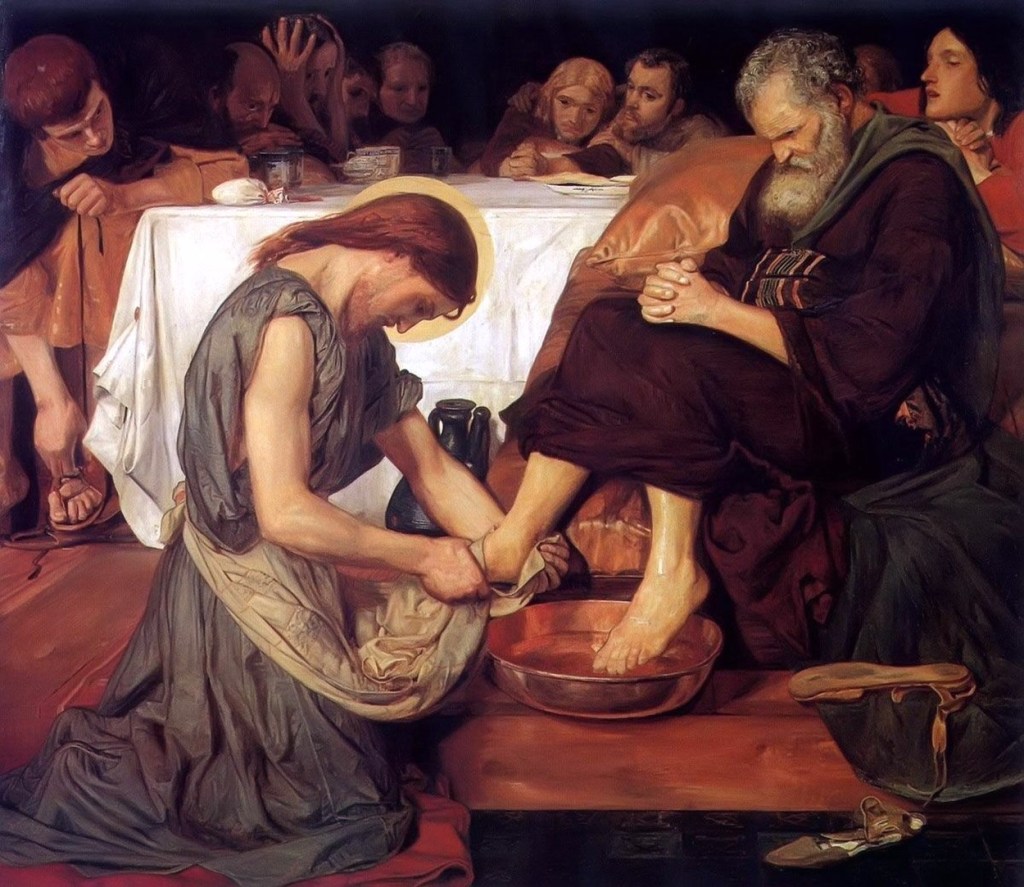
Image released under Creative Commons CC BY-NC-ND 4.0 DEED
From a physical point of view, Jesus is cleaning the dirt, dust, etc. off of the feet of His disciples. Jewish men and women would occasionally bathe their body, but regularly wash their feet because that was the dirtiest part of their body. John 13:4-5 gives us the details of this practice, Jesus “rose from supper and laid aside His garments, took a towel and girded Himself. After that, He poured water into a basin and began to wash the disciples’ feet, and to wipe them with the towel with which He was girded.” Old Testament scholar Andreas Köstenberger notes: “The practice of footwashing, which has a long Old Testament tradition, usually was performed by slaves.” Mike Cosper adds, “Some rabbis taught that this task was so lowly and demeaning that it was unacceptable to have a Jew do it—even if he was a slave.” Jesus was willing to do this, but why?
Spiritual Cleansing
From a spiritual point of view, Jesus is teaching them the importance of regular cleansing of the stain of sin. Hebrews 12:1 speaks of laying aside “the sin which so easily ensnares us.” We learn this through Jesus’ conversation with Peter when Peter initially rebuffed Jesus’ act. Jesus said, “What I am doing you do not understand now, but you will know after this…He who is bathed needs only to wash his feet, but is completely clean; and you are clean…” (John 13:6-10). We learn from Jesus’ response that there is deep symbolism in this act. Jesus’ words to Peter show that those who are bathed (e.g. born again through justification) do not need to keep taking baths (born again again or re-justified), they only require washing their feet (confessing of sin and growing in faith through sanctification; see 1 John 1:9). In other words, those who are clean are justified once (bath) and being sanctified continually (washing feet).
An Act of Service
While Jesus’ washing of His disciples’ feet was an act of cleansing, it was primarily done as an act of service. Jesus washed His disciples feet as an example of the humble service His followers should perform in His name. He said, “Do you know what I have done to you? You call Me Teacher and Lord, and you say well, for so I am. If I then, you Lord and Teacher, have washed your feet, you also ought to wash one another’s feet. For I have given you an example, that you should do as I have done to you” (John 13:12-15). Jesus performed a humble service that was an example for His followers to follow. We also remember that His disciples would argue about which one of them was the greatest (see Matthew 18:1-4; Mark 9:33-36; Luke 9:46-47). We need to be clear, Jesus did this as an example, not a command. Why is this an important distinction? Because Jesus is establishing a principle, not a specific practice. Jesus knows that not every culture will have people walking in sandals on dusty streets. The practice is only important as long as it fulfills the principle. What is the principle? The principle is that we should humbly serve one another sacrificially. What are some modern day equivalents? A few examples come to mind:
- One woman at our church on a Sunday night saw a young boy walk in with dirt all over him. She immediately began helping him wash his hands and face.
- Another woman at our church saw a very messy bathroom on a Wednesday night and proceeded to clean it up without making a scene or causing anyone embarrassment.
- Two men taking time off from very busy schedules to pick up a Lift Chair for a member of our church in a nursing home.
- And there are countless other examples that can be given.
What do these have in common and how do they compare with foot washing? They are humble acts of service that are not done for show, but for God’s glory and the good of others.
An Act of Love
Finally, Jesus’ washing of His disciples’ feet was an act of love. We are told by John, “when Jesus knew that His hour had come that He should depart from this world to the Father, having loved His own who were in the world, He loved them to the end” (John 13:1). Jesus was willing to do this because He loved them. John tells us that “God is love” (1 John 4:8) and everything He does is through love. God the Father sent His Son into the world as an act of love (John 3:16). Jesus said, “As the Father loved Me, I also have loved you; abide in My love” (John 15:9). We abide in Jesus’ love and it is the basis by which we love one another (John 13:34).
Knowing the love of Christ, we serve one another sacrificially (John 15:12-13). This is Jesus’ application of loving His disciples to the very end: washing their feet. John tells us about what Jesus was thinking as He did this. He wrote, “Jesus, knowing that the Father had given all things into His hands, and that He had come from God and was going to God” (John 13:3); washed His disciples feet. D.A. Carson wrote that this was “an act that simultaneously anticipated the unique cleansing affected by his impending death and left an example for His disciple to emulate.”
We also reflect on Jesus’ ultimate act of humble service and cleansing: the cross. Paul wrote, “For when we were still without strength, in due time Christ died for the ungodly. For scarcely for a righteous man will one die; yet perhaps for a good man someone would even dare to die. But God demonstrates His own love toward us, in that while we were still sinners, Christ died for us” (Rom 5:6-8). Let us, therefore, love one another. Let us show our love for one another in our actions. Let us be willing to humbly serve one another because we love God and we love one another. Hear Jesus’ words, “If you know these things, blessed are you if you do them” (John 13:17). We can do this because we know that we will one day go to God and dwell with Him forever.

 First Baptist Scott City, MO
You must be logged in to post a comment.