Pilate is stuck between a rock and a hard place. An angry mob wants him to condemn an innocent man. Pilate thought he had an escape. He said to the crowd, “You have a custom that I should release someone to you at the Passover. Do you therefore want me to release to you the King of the Jews?” To his dismay, the crowd did not want the innocent man but a criminal released. What should Pilate do? In this case, Pilate gave into the mob’s demands and Jesus was put to death. Pilate and the mob didn’t know this at the time, but Jesus taking Barabbas’ place foreshadows Jesus taking our place. In today’s sermon, we will consider how this points us to the Gospel and the forgiveness of our sins.
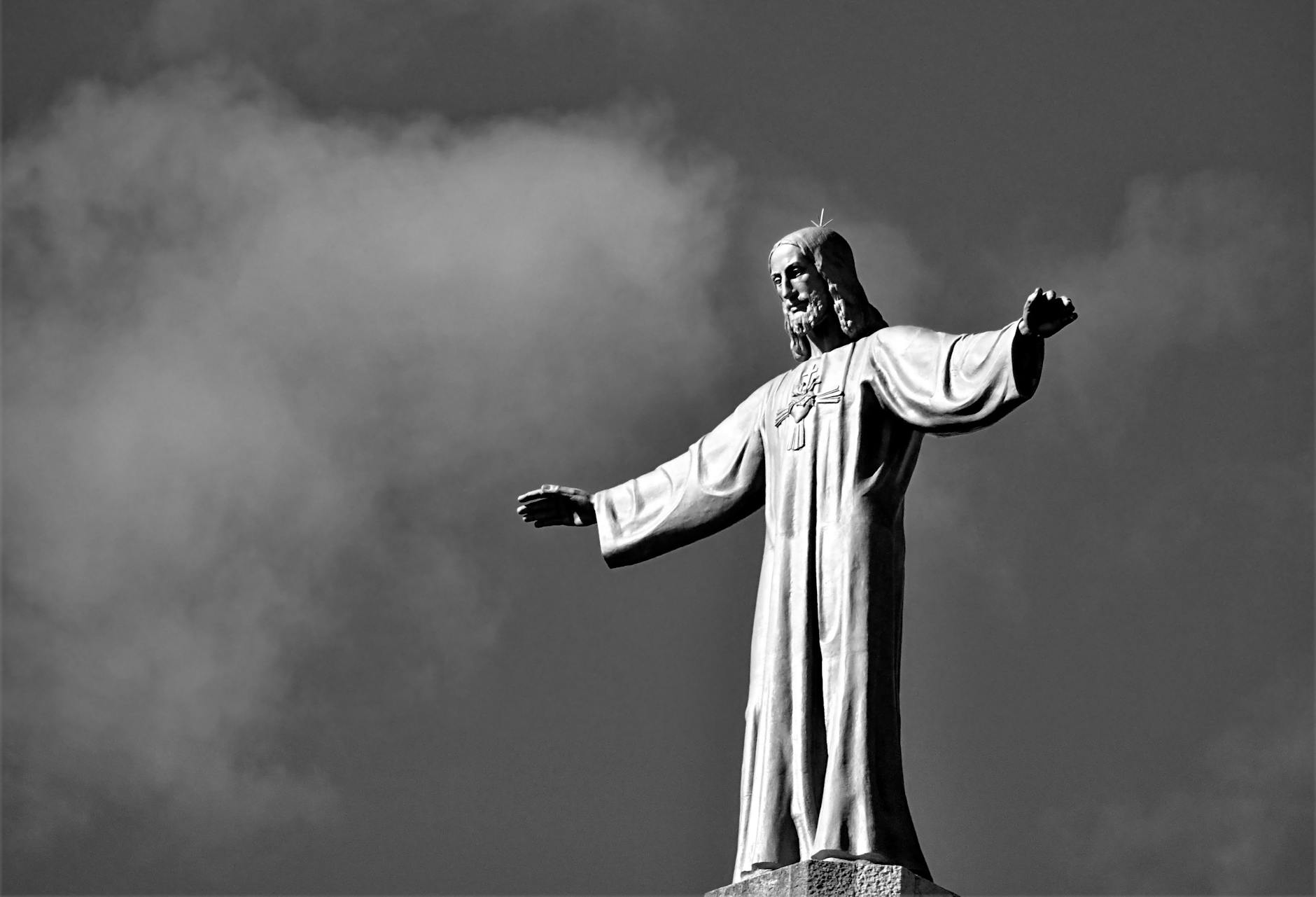
The Innocent is Condemned
Jesus is not worthy of condemnation because He is perfectly righteous and without sin. Pilate declared before the mob that he finds no fault in Jesus worthy of death. This isn’t just Pilate’s decision. When Jesus was baptized, the Father’s voice from heaven declared: “You are My beloved Son. I take delight in You!” (Luke 3:22). He is worthy of our love, honor, and worship; but He is not worthy of condemnation. Hebrews 4:15 says, “For we do not have a high priest who cannot sympathize with our weaknesses, but was in all points tempted as we are, yet without sin.” Paul wrote, “For He made Him who knew no sin to be sin for us, that we might become the righteousness of God in Him” (2 Cor 5:21).
Jesus is “Lord of all” (Acts 10:36) and the Creator of all things (John 1:3). Jesus obeyed the commands of the Father perfectly, did nothing wrong, bad, or sinful. Jesus fulfilled the Law (Matt 5:17). Jesus’ righteousness is unique to Him and makes Him very special. Jesus has true righteousness and is not worthy of condemnation; therefore, He is “a lamb without blemish and without spot” (1 Pet 1:19). This righteousness establishes that Jesus does not deserve to die. Romans 6:23 says that the “wages of sin is death.” Jesus did not deserve to die but deserves life. He can die for the sins of others since He doesn’t have to die for His own sins.
The Guilty Go Free
Jesus is innocent, but the crowd does not call for His release. Instead, they ask for Barabbas. John tells us that Barabbas was a “robber” (18:40). Luke tells us a little more: “Barabbas…had been thrown into prison for a certain rebellion made in the city, and for murder” (Luke 23:19). Matthew mentions that he was a “notorious prisoner” (Matt 27:16). Barabbas was a criminal who deserved His punishment, but was set free and released to the crowd.
Who is Barabbas? His name “Son of a Father” is not much help. He was an actual person and we can also see ourselves in him. Like Barabbas, we are worthy of condemnation because we are not righteous. We are guilty of sin. A large number of people, however, are deceived about their own goodness. All you have to do is ask someone: “Do you consider yourself to be a good person?” Most people will answer “Yes, I am a good person” for one or more of the following reasons: 1) there are certain things they have avoided, 2) there are certain things they do, and/or 3) the good things they do outweigh the bad things they do. The Bible, however, gives a different answer: “There is none righteous, no, not one” (Rom 3:10). The Bible says that all people are worthy of condemnation (Rom 6:23) because they are sinners (Rom 3:23). Even our good works are comparable to filthy rags (Is 64:6) in God’s sight because we cannot in our natural state please God (Rom 8:8).
The Bible says that we are born sinners. Adam’s rebellion in the Garden of Eden (Gen 3) brought sin and death into the world (Rom 5:12). Through “one man’s offense judgment came to all men, resulting in condemnation” (Rom 5:18). To put it another way: We are not sinners because we sin, but we sin because we are sinners. We inherit from Adam—our forefather—a sinful nature that brings us into this world spiritually dead (Eph 2:1). Our sin comes from our rebellion against God that we inherited from Adam. It is out of our heart that sin and evil comes (Matt 15:18-19). This is why we are worthy of condemnation and (contrary to popular opinion) are not good people. We are guilty of breaking God’s divine law (James 2:10). Paul wrote that unbelievers are “treasuring up for yourself wrath in the day of wrath and revelation of the righteous judgment of God, who will render to each one according to his deeds” (Rom 2:5-6).
The Propitiation is Made
Andrew Wilson, writing for Christianity Today, makes a very good point. He wrote:
If we reflect for a moment, it becomes clear this is not merely an exchange, but a substitution. Jesus doesn’t just die instead of Barabbas; he dies in his place as his substitute, his representative. We know this because—and this is often missed—Barabbas and Jesus stand accused of the same crime: sedition, insurrection, treason…Few examples of substitutionary atonement in Scripture are clearer than Jesus, the innocent man, taking the penalty so that none remains for the guilty Barabbas.
Have you ever wondered what happened to Barabbas after he was released? Did he go back to plotting insurrection and committing murder? Did he have a change of heart and become a follower of Jesus? We are not told in Scripture, but what about you? Jesus was Barabbas’ substitute that day, but is He also your substitute? When Jesus went to the cross, He made “propitiation for the sins of the people” (Heb 2:17). To propitiate means to make a sacrifice that turns aside wrath. God is just and cannot overlook sin, but He sent His Son to propitiate so that He can forgive sin and remain just and the justifier of the one who has faith in Jesus (Rom 3:25-26). Jesus’ death on the cross is the perfect sacrifice for sins that completely satisfied God’s wrath against sin. If you are not in Christ, you are still in your sins and the wrath of God is upon you. If you die in your rebellion, you will be judged in the lake of fire for eternity. Come to Jesus and be saved. Repent of your sins and be healed. Admit you are a sinner and Believe that your only hope is found in Jesus. Receive the free gift of salvation by grace through faith. If you are in Christ, you are forgiven, cleansed, and set apart for His service. If you are a Christian, Jesus took your place in death to give you life. What are you doing with it? When you are saved, God puts in you a new heart and a new spirit (Ez 36:26-27) so that you can “love the Lord your God with all your heart, with all your soul, and with all your mind…[and] love your neighbor as yourself” (Matt 22:37-39). Jesus died so that we may live. This life we live is because our sins are forgiven and we have received the righteousness of Jesus. Let us live for Him and for His glory!

 First Baptist Scott City, MO
You must be logged in to post a comment.