Eyewitness testimony is not without its flaws (e.g., people can be mistaken or not see the whole picture), but it is proven to be very valuable to detectives and jurors. Firsthand testimony is vital to understanding what has taken place. For example, one reason we know of the horrific conditions of Nazi death camps is because of people like Corrie Ten Boom who survived one. Her testimony and that of many others captured our attention and caused us to say: “Never again!”
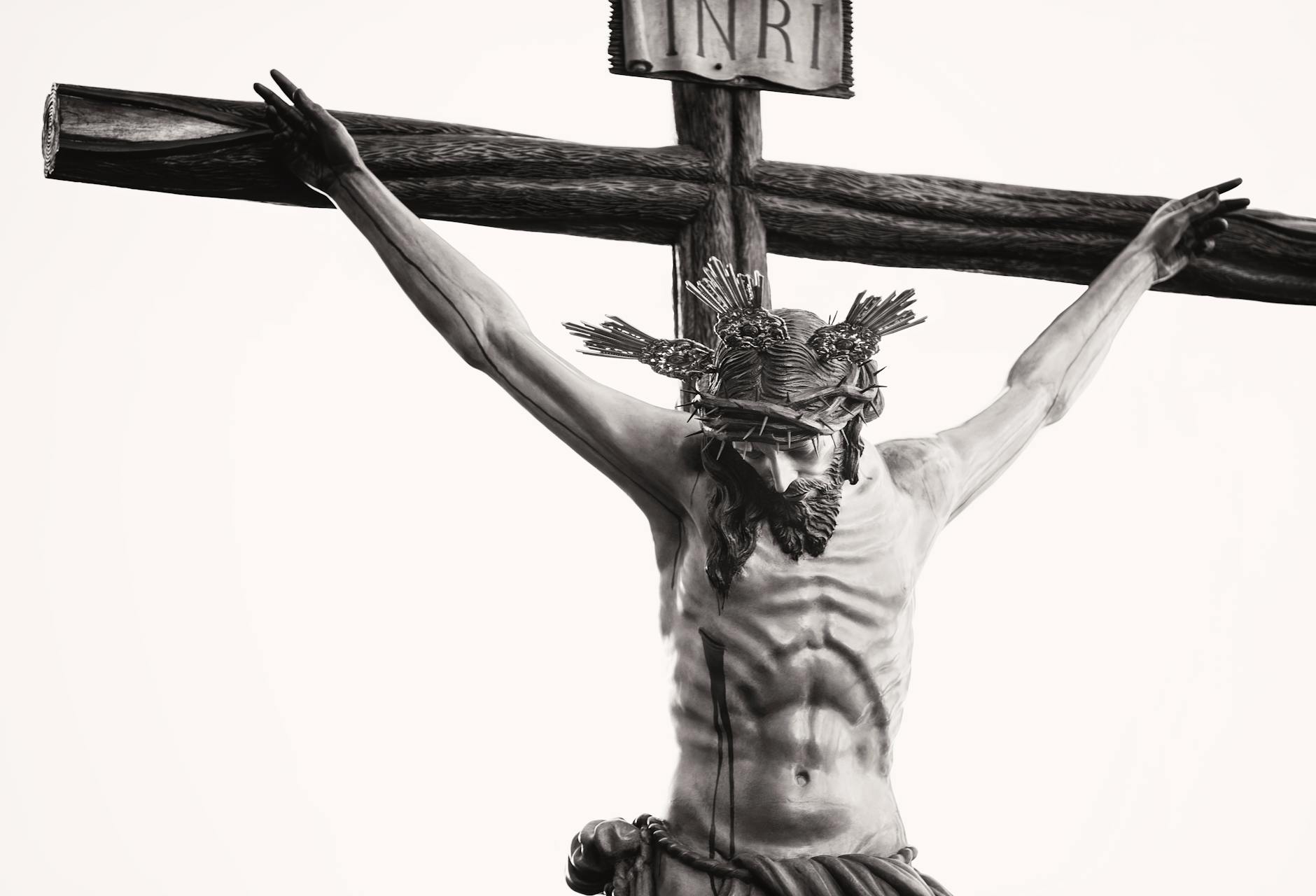
John is an eyewitness that demands our attention. John is a disciple of Jesus who is an eyewitness of Jesus’ crucifixion (19:26). He gives first-hand testimony that Jesus died. Why is it important to know that Jesus truly died? It is because Jesus’ death is a crucial part of His work of redemption. This is because His death is not for His own sins but for ours. Therefore, it is vital that we be certain that He actually died and not just “seemed” to die. Jesus’ death fills us with sorrow and joy. Sorrow because the author of life has been put to death. Joy because His death brings us eternal life. This morning, let us hear from the disciple whom Jesus loved (and who greatly loved Jesus) about what he witnessed when Jesus was crucified so that we would believe in Jesus and have life in His name.
The Inscription
John tells us about the inscription placed on the cross by Pilate: “Jesus of Nazareth, The King of the Jews”. The Jewish leaders did not want the inscription to say this, but “He said, ‘I am the King of the Jews.’” Pilate refused to change it, saying: “What I have written, I have written.” Pilate might have been motivated out of spite against the Jewish leaders, but His inscription is important.
Why does John mention this? This inscription accurately captures the charge against Jesus leading to His death (sedition) and accurately describes His true identity as “The King of the Jews”. Jesus is the long awaited Messiah. John mentions the inscription because it is important to note that Jesus was crucified as the King of the Jews. He willingly died as the head and representative for His people. Even though the people rejected Him, Jesus is nonetheless their King. Jesus did not go to Jerusalem to sit on a throne (John 18:36), but to the cross to make an atoning sacrifice for sins (1 John 2:2). Jesus didn’t drive out Pilate and Herod, but the money changers in the Temple (Matt 21:12-13). John mentions the inscription as further proof of Jesus’ love for us and so that we would believe in Him and have life in His name.
The Prophecy
John tells us about the prophecy concerning Jesus’ tunic. When a person is crucified, their clothing is fair game for the soldiers. When Jesus was crucified, the soldiers divided Jesus’ garments among themselves, but stopped when they came to His tunic. Jesus’ “tunic was without seam, woven from the top in one piece.” This tunic was considered valuable by the soldiers. They said, “Let us not tear it, but cast lots for it, whose it shall be.” They didn’t realize this but this happened “that the Scripture might be fulfilled which said, They divided My garments among them, and for My clothing they cast lots” (Ps 22:18, John 19:24).
Why does John mention this? This seems like an insignificant event, but it is profound. The actions of the soldiers fulfilled prophecy about Jesus’ death. While the soldiers acted of their own freewill, this act was done “that the Scripture might be fulfilled” (19:24). God is in control of the situation, not the soldiers or Pilate. John mentions the prophecy as further proof of Jesus’ love for us and so that we would believe in Him and have life in His name.
The Instruction
John tells us about the instruction Jesus gave to John concerning Mary: His mother. Jesus was hanging on the cross near death and saw His mother and John. He said to His mother, “‘Woman, behold your Son!’ Then He said to the disciple, ‘Behold, your mother!’ And from that hour that disciple took her to his own home” (19:27).
Why does John mention this? Jesus is full of grace, love, and mercy. He cannot help but care for those whom He loves. Jesus was in agony on the cross, but He took time to care for His mother. Jesus loved His own to the very end (13:1). In one of Jesus’ last acts before His death, He loved His mother so much that He wanted to make sure she was cared for by one of His disciples. Roman Catholics will point to this verse as “proof” that Mary did not have any other children (especially sons). Why else, they argue, would Jesus entrust His mother to John when Mary had other sons who would take care of her? The answer is that the brothers of Jesus did not believe that He was the Messiah (John 7:5) and anyone who confessed that Jesus was the Christ would be put out of the synagogue (John 9:22). This means that Mary needed someone who could care for her who was also put out of the synagogue. John mentions the instruction as further proof of Jesus’ love for us and so that we would believe in Him and have life in His name.
The Declaration
John tells us about Jesus’ declaration that “It is finished!”. John tells us, “After this, Jesus, knowing that all things were now accomplished, that the Scripture might be fulfilled, said, ‘I thirst!’ Now a vessel full of sour wine was sitting there; and they filled a sponge with sour wine, put it on hyssop, and put it to His mouth. So when Jesus had received the sour wine, He said, ‘It is finished!’ And bowing His dead, He gave us His spirit” (19:28-30).
Why did John mention this? John wants us to know that not only did Jesus willingly go to the cross to be crucified, He determined when His last breath would be drawn. Jesus would not die until He knew His work of redemption was finished. Jesus submitted Himself to death. He took our sin upon His body and surrendered His body to death. He died for us so that we might live for Him. He died as a sin offering so that sin might be put to death in His body. John mentions this declaration as further proof of Jesus’ love for us and so that we would believe in Him and have life in His name.
Jesus’ death fills us with sorrow and joy. Sorrow because the author of life has been put to death. Joy because His death brings us eternal life. Let us behold Jesus! Let us behold our King and His great love for us while we were yet sinners and the sufferings He endured for us! J.C. Ryle says:
Great must be the love of the Lord Jesus to sinners, when He could voluntarily endure such sufferings for their salvation. Great must be the sinfulness of sin, when such an amount of vicarious suffering was needed in order to provide redemption.
John is an eyewitness who testifies that Jesus was crucified. His testimony is true (21:24). He mentions the inscription, the prophecy, the instruction, and the declaration as sufficient proof of Jesus’ love for us and so that we would believe in Him and have life in His name.


You must be logged in to post a comment.